Questions And Answers

Nogales Commercial Roofing FAQ

This Nogales commercial roofing FAQ answers questions about TPO, EPDM, industrial, and metal roofs, monsoon and freeze wear, permits by community, and inspections.

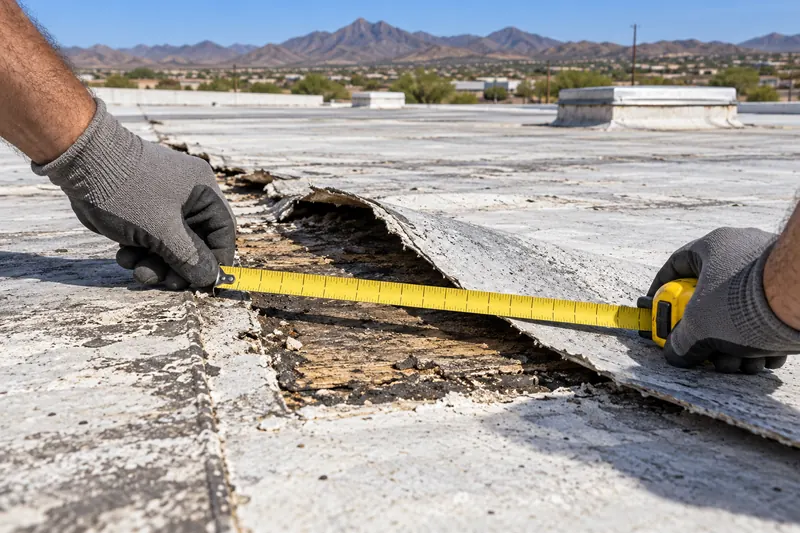
Tape measure across a wind-lifted membrane edge on a flat roof

Nogales sits near 3,800 feet on the Mexico border, so its commercial roofs face a different mix than lower desert towns. They get summer storm runoff, winter nights below freezing, and long stretches of strong sun. Produce warehouses, cold storage, retail strips, offices, and light industrial shells line the corridors around the Mariposa Port of Entry and Rio Rico.

Roof Systems

Is TPO a good roof for a Nogales produce warehouse or cold storage building?

Often, yes. A white TPO membrane reflects much of the summer sun, which can help buildings where coolers and refrigeration run hard from spring through fall.

TPO seams are heat-welded, so large low-slope roofs can be sealed in long, continuous runs. On a cold storage building, we also look at:

  • Condensation risk where cold interior air meets warm deck surfaces
  • Rooftop condenser units and the foot traffic they bring
  • Walkway pads around equipment so service crews don't wear through the membrane
  • Insulation thickness under the membrane, which matters as much as the color on top

When does EPDM make more sense than TPO in Santa Cruz County?

EPDM suits roofs that see big temperature swings or have lots of penetrations and odd shapes. The rubber stays flexible through cold winter nights and hot afternoons.

Black EPDM absorbs heat, so it fits best on buildings with modest cooling needs, such as storage, shop, or ballasted roofs. White EPDM exists for owners who want reflectivity. Seams are taped or adhered rather than welded, so seam detailing and inspection carry extra weight during monsoon season.

What counts as industrial roofing around the Mariposa Port and Rio Rico?

Industrial roofing covers large-span buildings like distribution centers, cross-dock facilities, manufacturing shells, and equipment-heavy plants. These roofs carry more mechanical units, exhaust stacks, and skylights than a typical retail roof.

On these buildings, our work often involves:

  • Tear-off or recover decisions across tens of thousands of square feet
  • Phasing so dock doors and loading lanes keep moving
  • Reinforced membrane or metal details at heavy equipment curbs
  • Drainage planning for wide roofs that shed large volumes of storm water

When should a business in Nogales consider a commercial metal roof?

A standing seam or structural metal roof is worth a look on buildings with enough slope to shed water, such as pre-engineered steel buildings, ag storage, shops, and newer retail.

Metal handles strong sun and wind well when it is fastened to the right uplift rating. Light-colored or coated panels reflect heat. The main watch points are fastener backout over many hot-cold cycles, sealant at trim and penetrations, and panel expansion on long runs.

Which commercial roof system fits which type of building?

The right system depends on slope, interior use, cooling load, and rooftop equipment. These pairings are a starting point for the inspection.

Building typeCommon fitWhy it works
Produce warehouse or cold storageWhite TPOReflects sun; welded seams on big flat areas
Older low-slope retail or officeTPO or EPDMDepends on deck condition and penetrations
Equipment-heavy industrial plantReinforced TPO or EPDMTough membranes with detailed curbs
Pre-engineered steel buildingStanding seam metalMatches the structure; sheds water fast
Shop or storage with little coolingEPDM or metalDurable with less focus on reflectivity

A roof inspection, including core samples where needed, confirms whether the existing deck and insulation can support the system you choose.

How long do TPO, EPDM, and metal roofs last in southern Arizona?

Lifespan depends on install quality, drainage, maintenance, and sun exposure, so treat these as general ranges rather than promises.

Roof systemTypical service life
TPO single-plyAbout 20 to 30 years
EPDM single-plyAbout 25 to 30 years
Commercial metalOften 40 years or more

In high-elevation desert sun, UV exposure and thermal cycling are the main aging forces. Regular inspection and quick repairs help a roof reach the upper end of its range.

Climate And Storms

How does the Nogales climate wear down a flat commercial roof?

The biggest stress is the swing between seasons. Summer brings heat and monsoon downpours, while winter nights often drop below freezing, so membranes and flashings expand and contract all year. Arizona State Climate Office data for Nogales show a normal of about 16 inches of rain a year, with most of it falling in July through September.

The same data average close to 100 nights a year at or below 32°F, plus more than 100 days at 90°F or hotter. That combination is harder on seams, sealants, and fasteners than steady heat alone.

What should building owners expect during monsoon season?

The National Weather Service office in Tucson defines Arizona's monsoon as June 15 through September 30. Storms in that window bring sudden heavy rain, strong downburst winds, blowing dust, and sometimes hail.

For a commercial roof, those storms tend to expose:

  • Clogged drains and scuppers that let water pond
  • Loose edge metal that wind can peel back
  • Open seams that leak only under driving rain
  • Dust buildup that holds moisture against the membrane

A pre-monsoon roof check in May or early June gives time to clear drains and fix weak spots before the first storm.

Do winter freezes really matter for roofs in Nogales?

Yes. Water that sits in cracks, blisters, or open laps can freeze overnight and widen the gap. Repeated freeze-thaw cycles slowly break down aged coatings and brittle flashing.

Roofs that pond water after rain are most at risk. Fixing drainage and sealing small openings in the fall helps keep winter damage from showing up as spring leaks.

Repairs, Upkeep, And Operations

Should I repair or replace my commercial roof?

Repair usually makes sense when damage is limited to a few areas and the rest of the roof is sound. Replacement becomes the better option when wet insulation, failed seams, or leaks keep spreading.

Repair is often enough whenReplacement is worth discussing when
Leaks trace to one flashing, curb, or seamLeaks show up in many unrelated spots
Insulation below is dryCore samples or scans find wet insulation
The membrane is mid-life and still flexibleThe membrane is brittle, shrinking, or cracked
Damage followed one storm eventPatches are failing faster than they are added

In some cases, a recover over the existing roof is possible. Local code limits how many roof layers a building may have, so an inspection decides whether tear-off is required.

Can roof work happen while my warehouse or store stays open?

In most cases, yes. We plan the work in sections so loading docks, entrances, and cold rooms keep operating.

How we keep a building running during roof work:

  • Phasing: We open only the roof area we can close up before the end of that workday.
  • Timing: Noisy tear-off can be scheduled early in the morning or around peak shipping hours.
  • Access: Material lifts and dumpsters go where they won't block trucks or customer parking.
  • Weather watch: During monsoon months, we track afternoon storm forecasts and dry-in early.
  • Interior protection: We cover sensitive inventory or equipment below active work areas when needed.

How often should a commercial roof in Santa Cruz County be inspected?

Twice a year is a good baseline: once in late spring before the monsoon and once in fall before freezing nights return. Add a check after any severe storm.

Routine maintenance usually includes:

  • Clearing drains, gutters, and scuppers of dust and debris
  • Checking seams, laps, and flashings for openings
  • Resealing pitch pans and penetrations where sealant has cracked
  • Tightening or replacing backed-out fasteners on metal roofs
  • Noting ponding areas that may need drainage changes

Permits And Incentives

Who issues roofing permits in Nogales and the surrounding communities?

It depends on whether the property sits inside a city or town or in unincorporated county land. Nogales and Patagonia are incorporated, while Rio Rico, Tubac, Tumacacori-Carmen, and Amado are unincorporated.

LocationJurisdiction typePermit authority
NogalesIncorporated city (county seat)City of Nogales Community Development
PatagoniaIncorporated townTown of Patagonia; its procedures note that Santa Cruz County's Building Department reviews plans
Rio RicoUnincorporated Santa Cruz CountySanta Cruz County Building Department
TubacUnincorporated Santa Cruz CountySanta Cruz County Building Department, plus historic zone review where it applies
Tumacacori-CarmenUnincorporated Santa Cruz CountySanta Cruz County Building Department
AmadoUnincorporated; mostly Santa Cruz County, possibly Pima County at the north endSanta Cruz County Building Department, or Pima County Development Services for parcels in Pima County

Whether a given roof job needs a permit depends on its scope. Re-covering, tearing off, or changing structure or rooftop equipment can each trigger different requirements, so we confirm with the right office before work starts. For Amado parcels, the county assessor record shows which county applies.

Does Tubac have historic or design review that affects roof work?

Yes, in part of the community. Santa Cruz County has a Tubac Historic Zone Advisory Board that reviews development and design plans for new buildings and for changes to existing structures inside the zone. Visible roof changes, such as a new metal roof or a different color, may need that review in addition to a building permit.

We check the board's page and the county's development review form before planning roof work on a building in the zone. We found no similar roof design review for commercial roofs in Nogales or the other listed communities.

Does UniSource Energy offer incentives that help with a commercial roof?

Possibly, but don't count on a roof rebate. UniSource Energy Services supplies electricity to most of Santa Cruz County, including Nogales, and its business programs mainly target lighting, HVAC, and refrigeration upgrades.

A few practical notes:

  • Program changes: Offerings, funding, and eligibility shift from year to year, so check UniSource's commercial rebate page before planning around one.
  • New construction: UniSource has a separate program for new construction and major renovations that may be worth asking about.
  • Cool roof ratings: When a program or code requires a reflective roof, it usually calls for a product listed in the Cool Roof Rating Council directory.
  • Indirect savings: A reflective roof may lower cooling load, which can stack with a refrigeration or HVAC upgrade that does qualify.

Taxes, Hiring, And Getting Started

Can a new commercial roof qualify for a Section 179 deduction?

It can. Federal tax rules let a business elect to expense certain improvements to an existing nonresidential building, and roofs are named among them. The roof has to be placed in service after the building itself was first placed in service.

Key points from IRS Publication 946:

  • Limit: The maximum Section 179 deduction for 2026 is $2,560,000, phased down once total qualifying purchases pass a set threshold.
  • Eligible buildings: Nonresidential property such as warehouses, retail, offices, and industrial buildings.
  • Excluded property: Residential rental buildings like apartment complexes don't qualify under this provision.
  • Next step: Your CPA decides whether expensing, depreciation, or another approach fits your tax picture.

We don't give tax advice, but we can document roof scope and dates so your accountant has what they need.

How do I verify a roofing contractor in Arizona?

Arizona contractors are licensed through the Arizona Registrar of Contractors. Before work starts, confirm the license is active and covers commercial roofing.

Also ask for proof of liability and workers' compensation coverage. Good questions cover who supervises crews on the roof, how rooftop safety is handled, and what manufacturer requirements apply to the system you choose.

What areas do you serve?

We serve commercial and industrial property owners in Nogales and nearby communities along the Santa Cruz River valley and Sonoita Creek, including:

  • Nogales: Port-area warehouses, downtown retail, and offices
  • Rio Rico: Distribution, cold storage, and light industrial sites
  • Tubac: Shops, galleries, and hospitality buildings, including the historic zone
  • Tumacacori-Carmen: Small commercial and agricultural buildings
  • Patagonia: Main street businesses and town-area commercial property
  • Amado: Roadside commercial and ag-related buildings along the I-19 corridor

How do I get started?

Call us or request a free estimate to set up a commercial roof inspection. The visit gives you a clear picture of the roof's condition before you decide on repair, recover, or replacement.

During the inspection, we check:

  • Membrane or panel condition, including cracks, blisters, and UV wear
  • Seams, flashings, and edge metal
  • Drains, scuppers, and signs of ponding
  • Rooftop equipment curbs and penetrations
  • Signs of wet insulation or deck damage, with core samples when needed
  • Interior leak stains that point to hidden problems

Question Not In This Nogales Commercial Roofing FAQ?

Call and ask about your own roof. Tell us the building type and what you are seeing, and we will answer from there.

+1 (623) 310-0169

Get A Free Estimate For A Commercial Roof

Start with the address and the roof size if you know it. An inspection turns these answers into a plan for your building.

Call +1 (623) 310-0169